
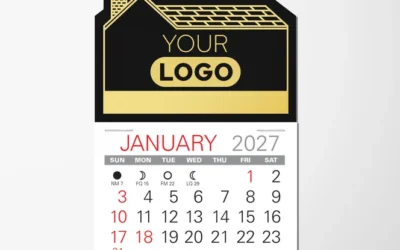
A perpetual calendar gives your brand a spot on someone’s desk or wall for years, not just for one January to December cycle. Most printed calendars land in the recycling bin the moment the year ends, but a perpetual calendar has no fixed year printed on it, so it never really goes out of date.
For businesses across Southern California, from professional offices in Irvine to franchise headquarters in Newport Beach, this reusable format turns a single print order into years of visible branding. Learn what sets a perpetual calendar apart, why more companies are switching to one, and how to customize it for your brand.
What Is a Perpetual Calendar?
Instead of printed dates, a perpetual calendar uses generic day and date grids, movable pieces, or repositionable cards that let you set the current month and date by hand. Once you have one on your desk or wall, you simply update it as time passes instead of replacing the whole piece every twelve months.
How Perpetual Calendars Differ from Annual Calendars
An annual calendar is designed to be thrown out. It has the year built into every page, so it stops being useful the moment the new year starts.
A perpetual calendar skips that problem entirely by leaving the year out of the design. You get a piece that keeps circulating in an office or home long after a standard calendar would already be in the trash.
If you want a closer look at how these two formats compare side by side, our guide on 2026 Calendar Design and Custom Printing breaks down when each format makes sense for your marketing goals.
Common Perpetual Calendar Formats (Desk, Wall, Block, Flip)
Perpetual calendars come in a few popular styles, each suited to different spaces and visual preferences:
- Desk calendars sit on an easel stand and work well for client-facing offices.
- Wall calendars use a reusable grid that you can wipe clean or reset each month.
- Block calendars use stacked wooden or acrylic cubes that you rotate by hand to show the date.
- Flip calendars use small cards or magnetic tiles you flip forward as the days pass.
Whichever style you pick, the goal stays the same: a piece your audience interacts with and sees every day.
Why Businesses Choose Perpetual Calendars
Businesses are moving toward perpetual calendars because they solve a real budgeting and branding problem. You still get a functional, everyday item, but you are not paying to reprint it every single year.
Extended Brand Visibility Without Annual Reprints
Every time someone glances at a calendar on their desk, they see your logo, your colors, and your message. A perpetual calendar keeps that exposure going for years instead of months, which means your branding stays in front of clients, employees, or prospects far longer than a standard giveaway would.
If you want to talk through what a reusable calendar program could look like for your brand, you can schedule a consultation to map out the right approach.
Budget and Sustainability Advantages
Reprinting a dated calendar every year adds up fast, especially if you are ordering for multiple office locations.
A perpetual calendar spreads that cost over several years instead of one, which frees up budget for other marketing materials. It also cuts down on waste, since fewer pieces end up in a landfill each January. For businesses that care about sustainability messaging as much as brand visibility, that combination is key.
Customizing a Perpetual Calendar for Your Brand
Since a perpetual calendar is meant to last, the materials and finishing choices behind it matter more than they would for a one-year piece.
Material and Durability Considerations
A calendar you plan to use for years needs to hold up to daily handling. Sturdier materials like thick cardstock, acrylic, wood, or metal tend to outperform thin paper stock, especially for block and flip formats that get picked up and rotated often. If your calendar will sit somewhere with heavy foot traffic, like a reception desk or a trade show booth, durability should be one of the first things you plan for.
Finishing Options (Spot UV, Foil, Recycled Stock)
The right finish can make a perpetual calendar feel like a premium branded item instead of a throwaway freebie. Spot UV coating adds a glossy highlight to your logo or key design elements. Foil stamping gives certain details a metallic accent that catches the eye.
Recycled stock supports a sustainability message while still looking polished. It is worth exploring premium finishing options like these to make sure your calendar reflects your brand the way you want it to.
You can also browse other branded marketing materials to see how a perpetual calendar might pair with the rest of your promotional lineup.
Choosing the Right Perpetual Calendar for Your Business
Not every business has the same use case, so the right perpetual calendar depends on where and how you plan to use it.
Office and Corporate Use Cases
Businesses with multiple locations, such as franchises, universities, and city offices, benefit the most from a lower reprint cycle.
Instead of coordinating a new calendar order every year across every site, you order once and let each location keep using the same piece for several years. That consistency also helps keep your branding uniform across every office, whether it is in South Orange County or another region entirely.
Client Gifting and Trade Show Use Cases
A perpetual calendar also works well as a client gift or trade show giveaway, since it keeps your brand visible on someone’s desk long after the event ends. Unlike a pen or a tote bag that might get lost or tossed, a calendar earns a permanent spot in a workspace.
If you are looking for more calendar formats to round out your promotional lineup, our roundup of Promotional Calendars for 2025 covers several other options worth considering. After you have narrowed down your use case, pairing a perpetual calendar with other branded promotional products can extend that visibility even further.
FAQ
How long does a perpetual calendar typically last?
Most perpetual calendars last several years with normal daily use, especially when made from sturdier materials like acrylic, wood, or thick cardstock. How long yours lasts depends on the material, the finish, and how often it gets handled.
Can a perpetual calendar be branded with a logo?
Yes. You can add your logo, brand colors, and messaging to nearly any perpetual calendar format, whether it is a desk easel, a wall grid, or a flip calendar. You can also get custom presentation packaging, making them an ideal turnkey option for client gifts or corporate events.
What’s the difference between a perpetual and a dry-erase calendar?
A perpetual calendar uses fixed but reusable date markers, movable pieces, or repositionable cards to show the current day. A dry-erase calendar uses a wipeable surface where you write the date and any notes by hand. Both are reusable, but they work differently depending on how much flexibility you want.
Are perpetual calendars more cost-effective than annual calendars?
Over several years, yes. You pay more upfront for a durable, reusable piece, but you avoid the cost of reprinting a new calendar every single year, which usually makes a perpetual calendar the more cost-effective choice over time.
Conclusion
A perpetual calendar gives your brand a longer shelf life than a standard annual calendar ever could, keeping your logo and message visible on desks and walls across California and beyond for years at a time.
Whether you need a piece for your own office, a client gift, or a trade show giveaway, choosing the right format and finish makes all the difference.
When you are ready to start planning your project, you can request a quote for custom perpetual calendar printing and get the process moving.
0 Comments